 (931) 542-9420
  riversidespinephysmed@gmail.com
  121 W Dunbar Cave Rd, Clarksville, TN 37040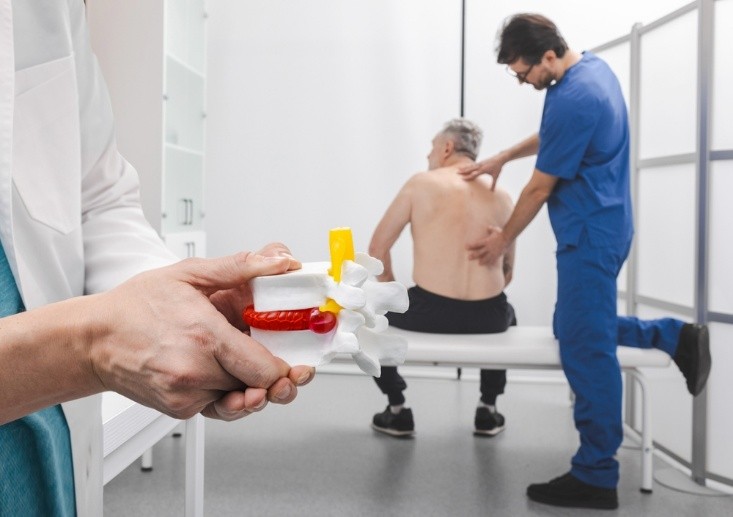
The Symptom That Brings People In Isn’t Always the Diagnosis
Most people searching for back pain relief in Clarksville aren’t looking for a diagnosis, they’re looking for the pain to stop. But the two are connected, and one common finding behind stubborn or radiating back pain in this region, particularly among Fort Campbell service members and active adults, is a herniated disc. Riverside Spine & Physical Medicine sees this pattern often enough to know that lasting relief starts with figuring out what’s actually generating the pain, not just treating where it hurts.
This guide explains what a herniated disc is, how it differs from general back strain, what conservative treatment can realistically accomplish, and when imaging becomes necessary.
What a Herniated Disc Actually Is
Spinal discs sit between each vertebra, acting as shock absorbers with a tough outer layer surrounding a soft, gel-like center. A herniation occurs when that outer layer weakens or tears, allowing inner material to push outward and irritate or compress a nearby nerve root. That’s what produces the radiating pain, numbness, or weakness commonly associated with sciatica.
Most herniated discs occur in the lumbar spine, often in patients with a history of repetitive loading, prior trauma, or heavy lifting, a profile that overlaps significantly with the Fort Campbell population and manual labor occupations across Montgomery County. It’s worth saying clearly: most herniated discs do not require surgery. The clinical literature consistently supports conservative care as the appropriate first step, with surgery reserved for severe or unresponsive cases. Riverside Spine & Physical Medicine approaches every new disc-related case with that framework in mind.
How to Tell Disc Pain From Muscular Back Pain
Not every backache is a disc problem, and treating one like the other slows recovery. A few distinguishing patterns help, though only a clinical exam confirms which is occurring:
- Disc-related pain often radiates, down the leg for lumbar herniations, into the arm for cervical ones
- Numbness, tingling, or weakness in a specific nerve distribution points toward nerve involvement
- Disc pain often worsens with sitting, bending forward, or coughing, which increase pressure within the disc
- Muscular strain stays localized and improves with rest faster than nerve-related pain
Progressive weakness, loss of bowel or bladder control, or saddle numbness warrant urgent evaluation rather than a standard treatment plan.
What Non-Surgical Herniated Disc Treatment Involves
For the large majority of patients, herniated disc treatment in Clarksville starts with a structured conservative program rather than a surgical referral. At Riverside Spine & Physical Medicine, that typically includes:
- Chiropractic care — targeted adjustments to reduce mechanical pressure and improve segmental motion
- Spinal decompression — a non-surgical approach creating negative pressure within the disc space to encourage retraction of herniated material in appropriate candidates
- Physical therapy — strengthening surrounding musculature and correcting movement patterns that load the spine poorly
- Activity modification — short-term adjustment of aggravating movements without prolonged inactivity, which often slows recovery
A growing body of research, including randomized trials, supports non-surgical spinal decompression for disc-related pain, with studies reporting meaningful pain reduction and, in some cases, measurable changes on follow-up imaging. It isn’t appropriate for everyone, pregnancy, fracture, active infection, tumor, and severe osteoporosis are contraindications, but for the right candidate it’s a genuine option many patients never hear about before a surgical consult.
Many patients see measurable improvement within four to six weeks of consistent care. Others, particularly with longer-standing symptoms, need a longer program. The honest answer depends on what the exam and any imaging show.
When Imaging and Further Workup Make Sense
Not every back pain case needs an MRI on day one. For most patients without red-flag symptoms, a clinical exam is sufficient to begin conservative treatment, with imaging reserved for cases that don’t respond as expected or where exam findings suggest imaging would change the plan.
Imaging becomes appropriate with progressive neurological symptoms, pain unimproved after a reasonable trial of conservative care, a history of trauma, or symptoms suggestive of something more serious. A clinician who orders imaging on every patient regardless of presentation is often substituting tests for an actual exam.
Frequently Asked Questions
Can a herniated disc heal without surgery?
Yes. Many herniated discs improve as the body resorbs herniated material and inflammation around the nerve root subsides. Conservative care, including chiropractic treatment, physical therapy, and in appropriate cases spinal decompression, supports that process.
How long does it take to recover from a herniated disc?
Most lumbar disc herniation patients see significant improvement within six to twelve weeks of consistent conservative treatment, depending on herniation size, symptom duration, and program consistency.
What’s the difference between a bulging disc and a herniated disc?
A bulging disc extends beyond its normal boundary without a tear, while a herniated disc has an actual tear that allows inner material to escape. Herniated discs are more likely to irritate nearby nerve roots and produce radiating symptoms.
Is chiropractic care safe for a herniated disc?
When performed by a qualified provider after proper evaluation, chiropractic care is a well-established conservative option for many disc-related conditions. At Riverside Spine & Physical Medicine, treatment is tailored to the specific herniation rather than a one-size-fits-all protocol.
When should I see a doctor for back pain instead of waiting it out?
Pain unimproved after one to two weeks, pain radiating below the knee or into the arm, numbness or weakness, or any loss of bowel or bladder control warrants prompt evaluation.
The Bottom Line
Back pain in Clarksville is rarely simple, and it’s almost never solved by ignoring it. Whether the cause is a herniated disc, mechanical strain, or something needing a closer look, the right start is an evaluation that identifies what’s happening before deciding what to do about it. Riverside Spine & Physical Medicine built its approach to back pain around exactly that: find the source, treat it directly, and reserve surgery for the cases that genuinely need it.